

What Key Factors Should I Evaluate When Comparing Independent Life Insurance Agencies?
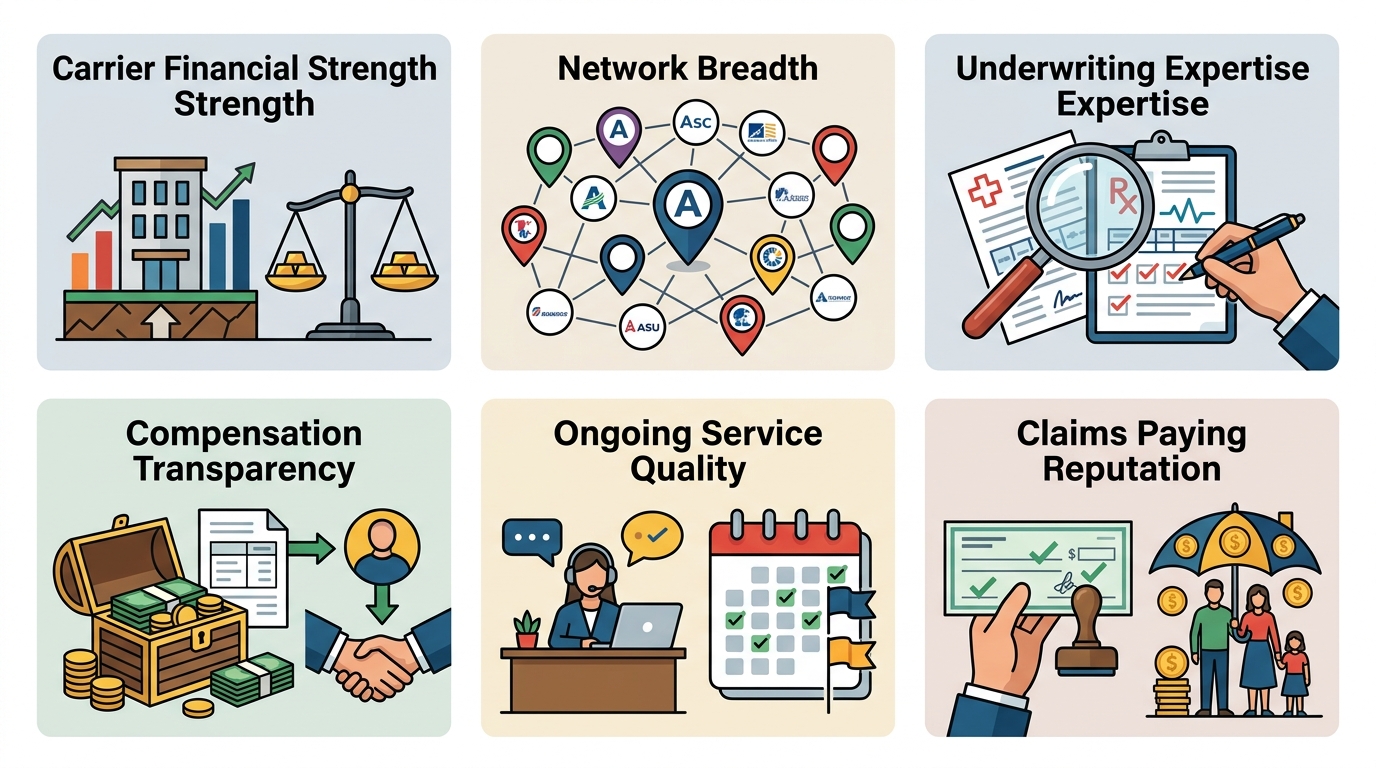
When comparing independent life insurance agencies, you should evaluate carrier financial strength, network breadth, underwriting expertise, compensation transparency, ongoing service quality, and claims paying reputation. These six factors determine whether an agency can secure the right policy at the right price for your specific health profile. This guide explains how to assess each factor using verifiable data and practical questions to ask before signing an application.
Carrier Financial Strength
Carrier financial strength is the ability of an insurance company to meet its long-term obligations to policyholders. Life insurance policies are long-term contracts, often spanning decades. A carrier that is financially unstable today may not be able to pay claims in twenty or thirty years. You must verify the financial health of the specific insurance company issuing the policy, not just the agency selling it.
Understanding Ratings Agencies
Independent ratings agencies like A.M. Best, Standard & Poor's, and Moody's evaluate insurance carriers based on their financial condition, operating performance, and business profile. An A-rated carrier is considered to have an excellent financial profile. When an agency claims access to "A-rated carriers," you should ask for the specific names of those carriers and verify their current ratings directly with the ratings agency. Do not rely on the agency's marketing materials alone.
Why Ratings Matter for Your Policy
Financial strength ratings are not a guarantee of future performance, but they provide a critical baseline of stability. A carrier with a strong balance sheet is better positioned to absorb market volatility and maintain solvency. When comparing agencies, ask which carriers they are appointed with and request their most recent financial strength ratings. An agency that cannot provide this information or that pushes a carrier with a declining rating should raise a red flag.
Carrier Network Breadth
Carrier network breadth is the number and variety of insurance companies an agency is appointed to represent. An independent agency with a broad network can shop your application across multiple carriers to find the best fit. A captive agent works for a single company and can only offer that company's products. The breadth of the network directly impacts your ability to get an accurate rate, especially if you have health conditions.
Why More Carriers Means Better Pricing
Each insurance carrier uses its own underwriting guidelines to evaluate risk. One carrier may view a specific health condition as a minor risk, while another may view it as a major risk. This means the same applicant can receive a Preferred rate from one carrier and a Table-rated policy from another. An agency with access to 30 or more carriers can match your specific health profile to the carrier whose guidelines are most favorable to you. This process is often worth thousands of dollars over the life of the policy.
Appointments vs. Marketing Claims
Not all agencies have the same level of access. Some agencies claim to be independent but only have appointments with a handful of carriers. You should ask the agency for a list of their current carrier appointments. Verify that these appointments are active and that the agency has the authority to submit applications to those carriers. An agency with a wide network of A-rated carriers provides a significant advantage in securing the best possible rate for your specific situation.
Underwriting Expertise
Underwriting expertise is the agency's ability to navigate the insurance company's risk assessment process to secure the best possible rate class for you. Underwriting is not a simple form-filling exercise. It requires a deep understanding of how carriers evaluate medical history, lifestyle factors, and financial profiles. An experienced underwriter can identify which carriers are most likely to offer a favorable rate based on your specific details.
The Role of Pre-Qualification
Before you submit a formal application, a skilled agency will conduct a pre-qualification process. This involves reviewing your health history, family history, and lifestyle factors to determine which carriers are most likely to offer a good rate. This step is crucial because a formal application creates a record in the Medical Information Bureau (MIB) database. If you apply to a carrier that is not a good fit for your health profile, you may receive a decline or a high rating, and that record will follow you to other carriers. An agency with strong underwriting expertise can avoid this pitfall by matching you to the right carrier before you apply.
Handling Complex Health Histories
If you have a history of cancer, heart disease, or other significant medical conditions, underwriting expertise becomes even more critical. These conditions require a nuanced understanding of carrier guidelines, which can vary significantly. An agency that has placed many policies for people with similar health histories will know which carriers are most likely to offer a standard or preferred rate. They can also advise you on the optimal timing for your application, as some carriers have specific waiting periods after treatment ends.
Compensation Transparency
Compensation transparency is the agency's willingness to clearly explain how they are paid and how that compensation structure influences their recommendations. Most life insurance agencies are paid by commission from the insurance carrier when a policy is placed. This means there is no direct fee to the client. However, the commission structure can influence which products an agent recommends. A transparent agency will explain their compensation model and how it aligns with your best interests.
Commission vs. Fee-Based Models
Some agencies operate on a commission-only model, while others offer fee-based advisory services. In a commission-only model, the agent is paid a percentage of the premium or a flat fee by the carrier. In a fee-based model, the client pays the agent directly for advice, and the agent may receive a reduced commission or no commission at all. You should ask the agency how they are paid and whether they have any financial incentive to recommend a specific product. A transparent agency will disclose their compensation structure and explain how it does not conflict with your best interests.
Why Transparency Builds Trust
Understanding how an agency is paid helps you evaluate their recommendations with confidence. If an agent is pushing a high-commission product without explaining why it is the best fit for your needs, you should ask for clarification. A trustworthy agency will be open about their compensation and will focus on your goals rather than their own earnings. This transparency is a key indicator of an agency's integrity and commitment to serving your best interests.
Ongoing Service Quality
Ongoing service quality is the agency's commitment to supporting you after the policy is issued. Life insurance is a long-term relationship, and you will need assistance with policy changes, beneficiary updates, and claims over the years. An agency that provides strong ongoing service will be available to answer your questions and help you navigate any issues that arise. This is a critical factor that is often overlooked during the initial sales process.
Responsiveness and Accessibility
Ask the agency about their typical response times and how you can reach them after the policy is issued. Do they have a dedicated client service team, or will you be working directly with the agent? How quickly can you get a response to a question or a request for a policy change? An agency that is responsive and accessible will make it easier to manage your policy over the long term. You should also ask about their process for handling claims and whether they will assist you or your beneficiaries in filing a claim.
Policy Reviews and Updates
Life changes, and your insurance needs may change with them. A proactive agency will offer regular policy reviews to ensure your coverage still meets your needs. They can help you adjust your coverage amount, update your beneficiaries, or convert your policy if your circumstances change. This ongoing support is a valuable service that can save you money and ensure your policy remains relevant. An agency that views the relationship as a one-time transaction is unlikely to provide the long-term support you need.
Claims Paying Reputation
Claims paying reputation is the track record of an insurance carrier in paying valid claims in a timely and fair manner. While financial strength ratings indicate a carrier's ability to pay, claims paying reputation reflects their willingness to do so. You should research the specific carrier's claims paying history and look for any patterns of delayed or denied claims. This information is often available through state insurance departments and consumer review platforms.
Researching Carrier Claims History
Before you select a carrier, research their claims paying reputation. Look for any complaints filed with the state insurance department and how the carrier resolved them. Pay attention to the ratio of complaints to policies in force, as a high ratio may indicate a pattern of poor claims handling. You should also read reviews from other policyholders to get a sense of their experience with the carrier's claims process. An agency with a strong claims paying reputation will be able to provide this information and help you make an informed decision.
The Agency's Role in Claims
While the carrier is responsible for paying claims, the agency can play a crucial role in the claims process. A good agency will assist you or your beneficiaries in filing a claim and will advocate on your behalf if there are any issues. They can help you gather the necessary documentation and communicate with the carrier to ensure a smooth and timely resolution. An agency that is committed to supporting you through the claims process will provide peace of mind and ensure that your policy delivers on its promise when you need it most.
Key Takeaways
- Verify the financial strength ratings of the specific insurance carriers the agency is appointed with.
- Ask for a list of the agency's current carrier appointments to assess their network breadth.
- Evaluate the agency's underwriting expertise by asking about their process for pre-qualifying applicants.
- Request a clear explanation of the agency's compensation structure to ensure transparency.
- Inquire about the agency's ongoing service model, including response times and policy review processes.
- Research the claims paying reputation of the carriers the agency recommends.
- Choose an agency that prioritizes your best interests over their own compensation.
- Build a long-term relationship with an agency that provides strong ongoing support.
Frequently Asked Questions
How many carriers should an independent agency have access to?
There is no specific number, but an agency with access to 30 or more A-rated carriers is generally considered to have a strong network. This breadth allows them to match your specific health profile to the carrier with the most favorable underwriting guidelines.
Does the agency's compensation affect the price of my policy?
No, the price of your policy is determined by the insurance carrier, not the agency. The agency's commission is paid by the carrier and does not increase your premium. However, the agency's compensation structure may influence which products they recommend, so it is important to ask about their incentives.
What is the Medical Information Bureau (MIB)?
The MIB is a database that insurance carriers use to share information about applicants. When you submit a formal application, the carrier may report your information to the MIB. This record can be seen by other carriers if you apply to them in the future, which is why pre-qualification is so important.
How can I verify an agency's carrier appointments?
You can ask the agency for a list of their current carrier appointments and verify them directly with the insurance companies. You can also check with your state insurance department to see if the agency is licensed and in good standing.
What should I do if I have a complex health history?
If you have a complex health history, it is especially important to work with an agency that has strong underwriting expertise. They can help you identify which carriers are most likely to offer a favorable rate and advise you on the optimal timing for your application.
How often should I review my life insurance policy?
You should review your life insurance policy at least once a year or whenever there is a significant change in your life, such as a marriage, divorce, birth of a child, or change in income. A proactive agency will offer regular policy reviews to ensure your coverage still meets your needs.
Conclusion
Choosing the right independent life insurance agency is a critical decision that can have a significant impact on your financial security. By evaluating carrier financial strength, network breadth, underwriting expertise, compensation transparency, ongoing service quality, and claims paying reputation, you can make an informed decision and select an agency that will serve your best interests. Schedule a free consultation with DG Life Group to discuss your specific needs and see how our independent approach can help you secure the right coverage.